Cheapside, London

This view of Cheapside (1890) was taken from St. Paul’s station looking East. You can see a statue of Sir Robert Peel who was twice Prime Minister, and also Home Secretary. In that role he established the Metropolitan Police in 1829.
Two weeks after his death in 1850 following a fall from his horse, the elders of the City of London met to discuss the establishment of a memorial to him. It was decided to erect a statue and, in July 1855, this 11-foot high bronze statue of Peel, standing on a 12-feet high granite pedestal was placed in the middle of the junction of Cheapside, Newgate Street and St Martin’s the Grand. Due to road congestion (probably caused by the statue), the statue was removed in 1934. It was agreed that the statue should be presented to the Metropolitan Police for display at the proposed new police college in Hendon. However, war intervened, the building of the college was delayed, and in 1939 the statue came back to the City to be placed in one of the outer recesses in the wall of the Bank of England, but it was too big. It was then stored in Old Street until 1952 when it was taken to Postman’s Park (the churchyard of St Botolph’s, Aldgate), where it stayed for 20 years.  In the early 1970s, the pre-war proposals for the Metropolitan Police Training Centre were coming to fruition. Following representations from the Metropolitan Police Commissioner and the Home Secretary, the statue returned to Hendon. Sir Robert’s statue was unveiled by Her Majesty the Queen when, in 1974, she opened the Metropolitan Police Training Centre.
Image: Getty Images
By January 2020, most of the buildings, with the exception of the church of St-Mary-le-Bow (on the right-hand side of the photo), have been redeveloped.
Image: © Steven Miell (TimeViews)
A merged version of the two photographs. Use the slider in the centre.

Old Church Street, Chelsea, London

A photograph of the monument to Sir Hans Soane, which is situated in the south-east corner of the Old Church in Chelsea. Soane died in January 1753, and was buried here a week later. The memorial is inscribed as follows:
To the memory of SIR HANS SLOANE BART President of the Royal Society, and of the College of Physicians; who in the year of our Lord 1753, the 92d of his age, without the least pain of body and with a conscious serenity of mind, ended a virtuous and beneficent life. This monument was erected by his two daughters ELIZA CADOGAN and SARAH STANLEY
Soane’s wife, Elisabeth, died in 1724 is also buried here. It is believed that this photograph was taken in the 1860s.
Image: Photographer unknown
By December 2021, the monument remains largely unchanged. However, the church behind it was almost completely destroyed by a German parachute mine in 1941. After the war, the church was rebuilt and re-opened in 1958.
Image: © Steven Miell (TimeViews)
A merged version of the two photographs. Use the slider in the centre.

King’s Road, London

Taken in 1908, this postcard photograph shows the Chelsea Old Town Hall in the King’s Road, Chelsea. This building was constructed in a Neoclassical style at a cost of £35,000. It was completed in 1907. For a while, it was the seat of government for the local council, but ceased to be that when the Royal Borough of Kensington and Chelsea was created in 1965. The Kensington and Chelsea Register Office was in this building and hosted several famous weddings including that of Judy Garland to Mickey Deans in 1969.
The interior of the building was comprehensively refurbished – completed in 2019.
Image: Courtesy of Kensington and Chelsea Council
I took this comparison photograph in December 2021. It was a question of waiting until the traffic was quiet – this was the quietest moment!
Image: © Steven Miell (TimeViews)
A merged version of the two photographs. Use the slider in the centre.

Fulham Road, London

Another view of the Michelin building in Fulham Road, London. Judging by the ‘passengers’ on the lorry on the right of the photograph, I assume this was taken at the time of the building’s opening in 1911.
Image: Photographer unknown
The same view in 2021 with the building fully restored.
Image: © Steven Miell (TimeViews)
A merged version of the two photographs. Use the slider in the centre.

Fulham Road, London

This art deco building in London’s Fulham Road was designed by an employee of tyre company Michelin’s employees, François Espinasse. Originally, the building had three large stained-glass windows – at the front, and on both sides. The windows were based on the ‘Michelin Man’ (Bibendum) and reflected Michelin’s advertisements of the day. Michelin House was opened on January 20 1911.
In 1927, Michelin built a factory in Stoke-on-Trent in Staffordshire, and a part of the Fulham Road building was left empty. From 1933 until the outbreak of World War 2, the upper storeys were let to various organisations – including the Air Ministry.
At that time, the three three stained glass windows were moved to Stoke-on-Trent for safe keeping. After the war, the windows were sought but had gone missing.
2011 marked the centenary of the opening of the building. At this point, Michelin renewed its efforts to locate the missing stained glass windows. However, they could not be found and were replaced by copies. Also, the glass lights on either side of the entrance – designed to represent piles of tyres – were also replaced.
Image: Photographer unknown
Now a restaurant and an Oyster Bar, by December 2021 the building has been fully restored.
Image: © Steven Miell (TimeViews)
A merged version of the two photographs. Use the slider in the centre.

Smithfield, London

The gatehouse to the church of St. Bartholomew The Great – one of London’s oldest churches – is one of a few survivors of Tudor London. The church was founded in 1123 as a priory, and It stands near Smithfield market. In 1536, during the dissolution of the monasteries, the church was largely destroyed. However, at the end of the 16th century, William Scudamore built his residence on top of the gatehouse. The building survived the Great Fire of 1666, as did a number of the houses in nearby Cloth Fair.
During the 18th century, a Georgian façade was constructed over the Tudor timbers and, for the following 200 years, the gatehouse was a shop. The damage caused by a German bomb dropped during a Zeppelin raid in 1917 revealed the original frontage
In 1932, the building was fully restored, and is now Grade II listed.
and even retains some of the 13th century stonework from the original nave. On the first floor of the property there is bolection-moulded panelling from around 1700, whilst the attic boasts original panelling dating back to 1595.
The gatehouse was used as a school between 1948 and 1979. Also, William Wallace was hanged, drawn and quartered in Smithfield – within 100 yards of the gatehouse.
Image: Photographer unknown (1940s)
The gatehouse in February 2020.
Image: © Steven Miell (TimeViews)
A merged version of the two photographs. Use the slider in the centre.

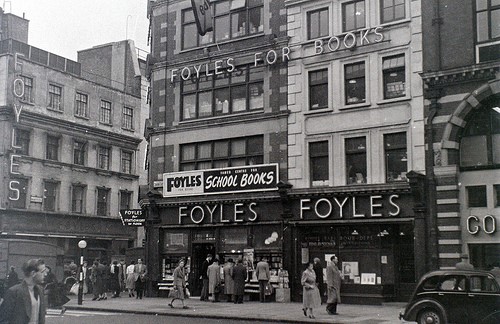
Charing Cross Road, London

The Foyle brothers (William and Gilbert) founded the ‘Foyles’ business in 1903. Both of the brothers had failed their entrance exams for the Civil Service and hit upon the idea of selling their textbooks from home. Soon after, they opened a small shop in Peckham with their first ‘West End’ shop opening in Cecil Court in 1904. They had moved to Charing Cross Road by 1906.
Image: Allan Hailstone (1950s)
By December 2017, the Foyles business had moved to another location in Charing Cross Road and the former site was being redeveloped.
Image: © Steven Miell (TimeViews)
A merged version of the two photographs. Use the slider in the centre.

Southwark Cathedral, London

Southwark Cathedral is situated on the south bank of the Thames – at the end of London Bridge. There has been Christian worship on this site for over 1,000 years, but only a cathedral since 1905 when the diocese of Southwark was created.
Although the nave is a late 19th-century reconstruction, the present building has retained the shape of the Gothic structure which was built between 1220 and 1420.
Image: Photographer unknown
From the same position in November 2021.
Image: ©TimeViews Steven Miell
A merged version of the two photographs. Use the slider in the centre.

Liverpool Street, London

Taken in 1960, this photograph shows the entrance to Liverpool Street Station – opposite the London Underground roundel. On the left, taxis are seen emerging from the sloping entrance to the station.
Image: Photographer unknown

In November 2021, the station has been completely transformed. The ‘Eastern Region Headquarters’ building is now a McDonald’s. Image: ©TimeViews Steven Miell
A merged version of the two photographs. Use the slider in the centre.

Threadneedle Street, London

A photograph taken along Threadneedle Street in the 1940s. On the right of the photograph is the Bank of England and at the end of the road is Bank station which was badly damaged in World War 2.
Image: London Picture Archive
A largely unchanged view in January 2020.
Image: © Steven Miell (TimeViews)
A merged version of the two photographs. Use the slider in the centre.