Bank, London Another view of the Royal Exchange building in the Bank area of the City of London. The Bank of England and Threadneedle Street is to the left of the photographer and the equestrian statue of the Duke of Wellington can be seen to the right. Image: Photographer unknown (1950s) In the July 2021 photograph taken from the same position, it is apparent that modern London is discouraging traffic from passing through this area. The proliferation of ‘street furniture’ can be seen. However, the buildings look much cleaner.Image: © Steven Miell (TimeViews) A merged version of the two photographs. Use the slider in the centre.
Trafalgar Square, London In September 1915, Emil P Albrecht took this photograph of one of Landseer’s lions in Trafalgar Square. This is one of the four lion sculptures by Sir Edwin Landseer, placed at the base of Nelson’s Column in Trafalgar Square. This lion is positioned in the south-west corner. All four lions are practically identical – each being 20 feet long and 22 feet high. The only differences are in their manes and the angles of the heads. They were put in place in 1867. Image: Emil P. Albrecht, National Geographic The same view in May 2020.Image: © Steven Miell (TimeViews) A merged version of the two photographs. Use the slider in the centre.
Piccadilly, London Looking west down Piccadilly towards Green Park. A photograph taken by David Rostance in April 1975.Image: David Rostance In ‘Coronavirus’ London in May 2020 – very quiet. Image: © Steven Miell (TimeViews) A merged version of the two photographs. Use the slider in the centre.
Gun Street, London Gun Street in London’s Spitalfields was originally part of an area of land which was once designated as part of the ‘Liberties’ of the Tower of London (from around 1200). That is, land that was previously part of the City of London. The area was converted to an artillery ground in 1538 for the use of ’The Fraternity or Guild of Artillery of Longbows, Crossbows and Handguns’. This group later became the Honourable Artillery Company (HAC). They were able to use the ground together with the ‘Gunners of the Tower’.In 1658, the HAC moved to Bunhill Fields leaving this area to the Gunners of the Tower. This situation persisted until 1682 when the land was sold to speculative builders. The street names in the area – Gun Street, Fort Street, Artillery Lane and Artillery Passage – remind everyone of the area’s history.Image: Gareth Watkins Photography (1980s) I took this photograph of the location in July 2021.Image: © Steven Miell (TimeViews) A merged version of the two photographs. Use the slider in the centre.
Whitehall, London A view of Whitehall from Trafalgar Square in 1910. The statue in the centre is an equestrian representation of Charles I. It was probably cast in 1633 by the French sculptor, Hubert La Sueur. It is located on the site of the most elaborate of the Eleanor Crosses which were erected by Edward I. The Cross had been on this site between 1300 and 1647 and was the place generally seen as the Centre of London – the place where distances from London were measured.The statue was commissioned by the King’s Lord High Treasurer (Richard Weston) and was initially located in his Surrey garden. After the English Civil War, the statue was sold for scrap to a Holborn-based metalsmith (John Rivett) who hid it until the Monarchy was restored. In 1675, it was installed in this location.During World War II, the statue was removed and stored at Mentmore Park. Some repairs were completed before its return. The Department of the Environment and the V&A Museum arranged for the plinth to be cleaned in 1977 – the first time in 300 years. Image: Photographer unknown The same view down a virtually empty Whitehall in May 2020 during the Coronavirus pandemic. Image: © Steven Miell (TimeViews) A merged version of the two photographs. Use the slider in the centre.
Station Road, Chingford, London Judging by the films showing – ‘Mantrap’ (with Clara Bow) and ‘Born to the West’ (with Jack Holt) – the photograph was taken in 1926 or 1927. At the time the cinema, on the corner of Station Road and Connaught Avenue in Chingford, was called ‘Chingford Pavilion Cinema’. It had opened in 1920 and was re-named ‘Chingford Cinema’ in 1929 after the introduction of films with sound. It was re-named (again) in 1941 and became ‘Doric Cinema’. It closed for a brief period between 1957 and 1959 when it re-opened as the ‘New Doric Cinema. It finally closed in 1961 and offices were built on the site.Image: Photographer unknown The same view in May 2020. The site is directly opposite Chingford railway station.Image: © Steven Miell (TimeViews) A merged version of the two photographs. Use the slider in the centre.
Horse Guards Road, London The Guards Memorial is located in Horse Guards Road, directly opposite Horse Guards Parade. The memorial commemorates the Guards Divisions’ war casualties from World War I, and those of the Household Division in World War II. Made of Portland stone, the memorial was designed by H. Chalton Bradshaw. There are five bronze sculptures facing Horse Guards Parade. They represent each of the Foot Guards regiments. The bronzes (statues and panels) were cast by the William Morris Art Bronze Foundry using bronze taken from German guns which had been melted down after World War I. The memorial was unveiled on October 16th 1926. It suffered damage from German bombs in World War II – this can be seen in the above photograph (taken in 1950). Some of the damage was left unrepaired as ‘honourable scars’.The memorial became a Grade II listed structure in 1970, and achieved Grade I status in 2014.Image: dianp As mentioned above, some of the damage from World War II can be seen in this May 2020 photograph – particularly above the soldiers’ heads.Image: © Steven Miell (TimeViews) A merged version of the two photographs. Use the slider in the centre.
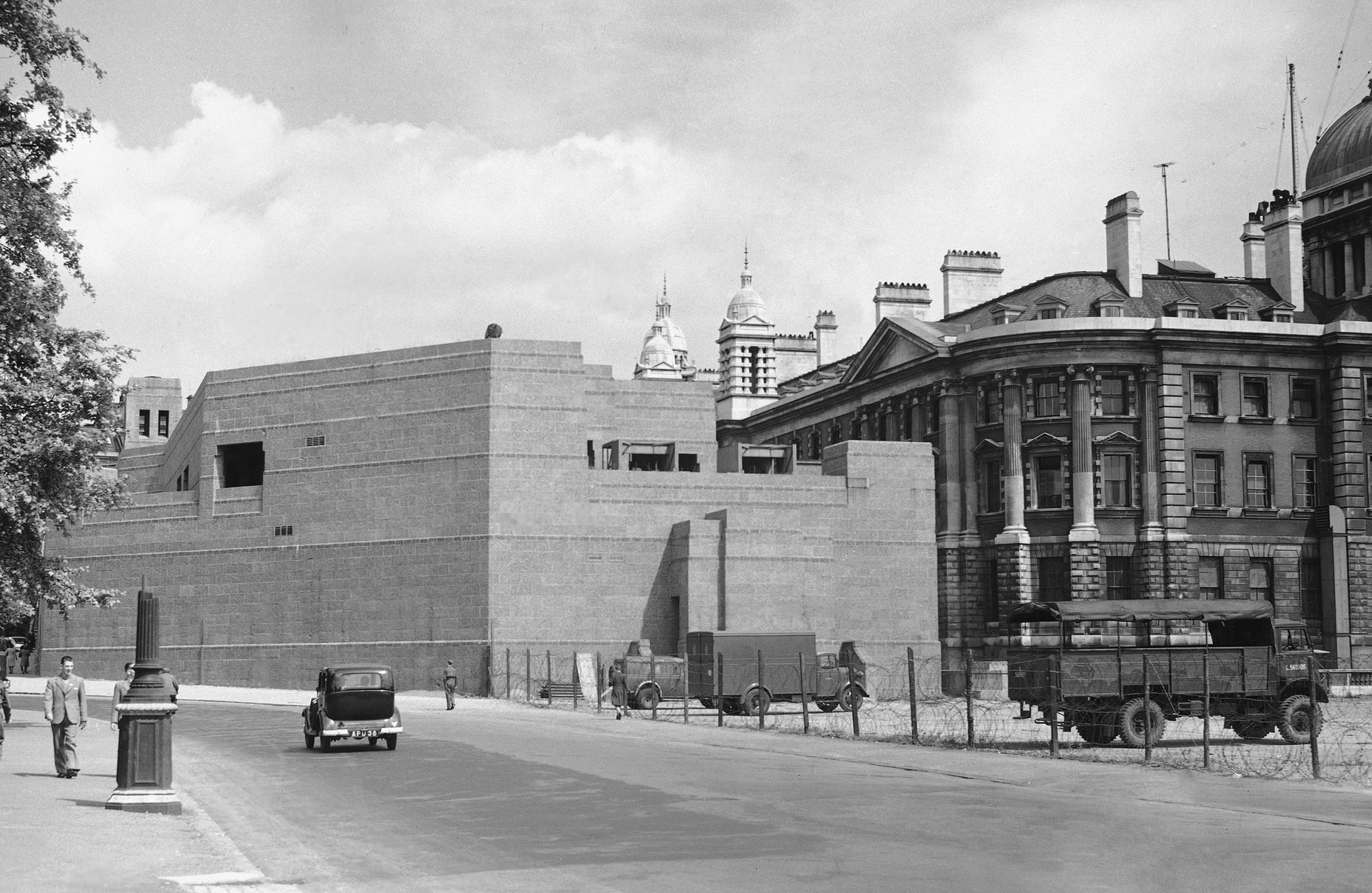
Horse Guards Road, London This photograph was released by the War Department in 1945 – just after the end of World War II in Europe. It shows the Admiralty Citadel which is located behind the Admiralty which is situated on Horse Guards Parade. It is the most visible citadel in London and was constructed between 1940 and 1941. It was built for the Admiralty as an operations centre. With its deep foundations (over 9 metres) and thick concrete roof (over 6 metres), it was intended to be fully bomb proof. Tunnels link the citadel to other government buildings around Whitehall. Sir Winston Churchill was not a fan of the building, describing it as a “…vast monstrosity which weighs upon the Horse Guards Parade”. In the event of a German invasion, it would have become a fortress for the Whitehall area. Over the years, Boston Ivy has been grown on the citadel to soften its brutal appearance. Image: Photographer unknown Today, the Admiralty Citadel continues to be used by the Ministry of Defence. This photograph was taken in May 2020.Image: © Steven Miell (TimeViews) A merged version of the two photographs. Use the slider in the centre.
Park Lane, London Park Lane is a broad and very busy road in central London. Park Lane runs from Marble arch in the north to Hyde Park Corner in the south. The road is home to a number of historically important properties and hotels and remains (despite the traffic) a desirable address.Originally a country lane which bordered Hyde Park, a number of aristocratic properties started to be constructed towards the end of the 18th century. These included Londonderry House, Dorchester House and Breadalbane House. During the 19th century it started to become a very desirable address due to its proximity to central London and its views of Hyde Park. Notable residents have included the Duke of Westminster and Disraeli. Luxury hotels started to appear in Park Lane during the 20th century including The Dorchester – completed in 1931 – and the London Hilton. Park Lane has been a busy thoroughfare since the 19th century. Since the 1960s, it has been a three-lane dual carriageway. Despite this, property prices here remain among the highest in London. Image: Photographer unknown In May 2021 I took this photograph for comparison. Park Lane is (probably) the busiest road in London and I took my life in my hands to get to the central reservation. Image: © Steven Miell (TimeViews) A merged version of the two photographs. Use the slider in the centre.
Piccadilly Circus, London The London Pavilion’s first incarnation was a music hall, built in 1859. It was formed by roofing over the yard of an Inn (The Black Horse). When Shaftesbury Avenue was constructed in 1885, much of the original site was lost. The ‘new’ London Pavilion (the present building) was built, and opened in November 1885. It became a luxury music hall and boasted marble-topped dining tables and other high-end features. In effect, it symbolised the transition of the music hall from its working class origins to a more sophisticated ‘West End’ experience. Noel Coward and Harry Lauder were among many artists to appear here in the following years.Electric billboards first appeared on the building in the early 1920s. The Pavilion was converted into a cinema in 1934 and hosted the premieres of many films including ‘The Private Life of Don Juan’, The Curse of Frankenstein’ and ‘Dr. No’. The above photograph was taken in July 1964 when the Beatles’ ‘A Hard Day’s Night’ was premiered. The London Pavilion closed as a cinema in 1981 and remained unused until 1986 when the interior was completely transformed. Only the 1885 façade, the outer walls, and the roof were retained. It plays host to various exhibitions and became part of the Trocadero Centre in 2000. Image: Luckhardt WC When this photograph was taken – in September 2017 – the London Pavilion was hosting ‘Ripley’s Believe It or Not’. With no hoardings or scaffolding, the Victorian frontage was again visible. Image: © Steven Miell (TimeViews) A merged version of the two photographs. Use the slider in the centre.




 TimeViews