Portland Place, London A photograph (taken in the early 1930s) of Broadcasting House – the BBC’s headquarters in Portland Place in London. The building was opened officially in May 1932 which helps to date this photograph because the Eric Gill statue (Prospero and Ariel) was not installed until 1932. The building is a good example of the ‘Art Deco’ style and was constructed using Portland stone placed over a steel frame. Image: Photographer unknown In the intervening years, Broadcasting House has been extensively renovated and extended. The building to the right in the first photograph was demolished and replaced by the new wing seen in the second photograph. In 2012, this wing was named the ‘John Peel Wing’ in tribute to the disc jockey. The main building was also refurbished with a large extension added to the rear of the existing building. Image: © Steven Miell (TimeViews) 2016 A merged version of the two photographs. Use the slider in the centre.
Royal Academy of Arts, Burlington House, Piccadilly, London In 1768, the Royal Academy of Arts (RA) was founded. Its mission was to ‘promote the arts of design in Britain through education and exhibition’. The painter Joshua Reynolds was the RA’s first president, and a statue of Reynolds can be seen in front of the entrance to Burlington House. The statue was erected in 1931 and is Grade II listed.The RA was initially based in a small building in Pall Mall. Following several moves, the RA moved to this location in 1868 – 100 years after the Academy’s foundation. Burlington House is owned by the British Government. One of London’s major annual events is the Royal Academy Summer Exhibition. Image: Photographer unknown (1930s) An unchanged view of Burlington House in May 2019.Image: © Steven Miell (TimeViews) A merged version of the two photographs. Use the slider in the centre.
Buckingham Palace, London Standing at the bottom of Constitution Hill, a Canadian businessman on a trip to London took this photograph of Buckingham Palace in May 1950, just five years after World War 2. King George Vl was the reigning Monarch.Image: DianP’s father From the same position in May 2019. The growth of the trees to the left of the Palace is very apparent.Image: © Steven Miell (TimeViews) A merged version of the two photographs. Use the slider in the centre.
Waterloo Place, London A foggy day in London’s Waterloo Place in 1959. The Duke of York Column can be seen in the photograph.Image: Kees Scherer A clearer day in March 2020.Image: © Steven Miell (TimeViews) A merged version of the two photographs. Use the slider in the centre.
Charing Cross Road, London Taken in 1955 by Allan Hailstone, this photograph shows Foyles – the best-known bookstore in London. It was founded by brothers William and Gilbert Foyle in 1903, and was initially a second-hand book business based at their home. Their first West End store was opened in Cecil Court in 1904. In 1906, they opened the Charing Cross Road store and quickly became London’s largest educational booksellers. Image: Allan Hailstone Towards the end of 2011, Foyles sold the lease of the building in the first photograph and moved to premises further down Charing Cross Road, previously occupied by the Central St. Martins College of Art and Design. The move was completed by June 2014 and in 2018 Foyles was purchased by Waterstones, who decided to retain the name. I took this photograph in October 2020. Image: © Steven Miell (TimeViews) A merged version of the two photographs. Use the slider in the centre.
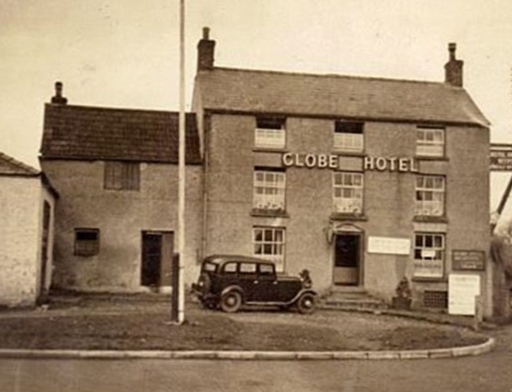
The Globe, Alvington, Gloucestershire The Globe Hotel in Alvington, Gloucestershire in the 1950s. Image: Photographer unknown After being abandoned for a few years, The Globe is now a very successful and popular pub in the village of Alvington.Image: © Steven Miell (TimeViews) – June 2018 A merged version of the two photographs. Use the slider in the centre.
St. John’s Wood Station, London St. John’s Wood station opened in November 1939, just after the outbreak of World War II. The photograph was taken in the 1950s. This new station replaced the ‘Lord’s’ (St’ John’s Wood Road) and ‘Marlborough Road’ stations which had closed the previous day. The station was on the Bakerloo line until it was transferred to the Jubilee line in May 1979. Also, the use of the apostrophe in ‘John’s’ is absent here, but present in the later photograph (below). The use of the apostrophe has been described as ‘intermittent’ but is declining.The station building – designed by Stanley Heaps – is now Grade II listed.Image: London Transport Museum In April 2017, flats built above the station can be seen, while the frontage and approach is largely unchanged.Image: © Steven Miell (TimeViews) A merged version of the two photographs. Use the slider in the centre.
High Road, Tottenham, London In October 2014, there were a few signs of the development of the new Tottenham Hotspur Stadium, and the old ‘White Hart Lane’ stadium can clearly be seen.Image: © Steven Miell (TimeViews) Two and a half years later (March 2017), the new stadium is growing rapidly and is swallowing the old one.Image: © Steven Miell (TimeViews) A merged version of the two photographs. Use the slider in the centre.
Albert Embankment, London In 1991, the construction of this building caught the eye of Steve Williams who took this photograph. The building was opened in July 1994 by H. M. The Queen and the Duke of Edinburgh as the headquarters of the UK’s Secret Intelligence Services (SIS) – or MI6. In the 19th century, the location of the SIS building was occupied by the Vauxhall Pleasure Gardens. When the Gardens were removed in the 1850s, industrial buildings occupied the site. These included a glass factory, a vinegar works and a gin distillery. Excavation of the site during construction found evidence of glass kilns dating from the 17th century, and also barge houses, and an inn called The Vine. Image: Steve Williams The project to construct the SIS HQ was approved in 1988 by the Prime Minister (Margaret Thatcher). There is a rumour that a tunnel exits from here to Whitehall. Also, the windows are triple glazed for security purposes. Large parts of the building are below street level, with numerous underground corridors linking areas in the building. This photograph was taken in January 2017.Image: © Steven Miell (TimeViews) A merged version of the two photographs. Use the slider in the centre.
Whitehall, London Another view of the Cenotaph in Whitehall. This one was taken at the Remembrance Day parade in November 1923. On the right hand side of the photograph is a B-Type bus (B43). These vehicles (900 in total) were used in WW1 to move British troops around. They were painted khaki and their windows were removed as they were prone to break – mainly due to contact with the soldiers’ rifles. The B-Type buses served until the end of the war. They were then used to help bring the troops home.In the 1920s, the B43 was withdrawn from service and was given the nickname ‘Ole Bill’ – after a caricature of a British soldier by Bruce Bairnsfather. An example of ‘Ole Bill’ can be seen in the Imperial War Museum.Image: Photographer unknown From the same spot in February 2017.Image: © Steven Miell (TimeViews) A merged version of the two photographs. Use the slider in the centre.




 TimeViews