King’s Head Hill, Chingford, London The King’s Head public house was first referred to in the early 1780s. It sits at the top of a steep hill leading to Enfield. The hill was named after the pub. Over the years, it has undergone many alterations and extensions. This photograph was taken in 1918.Image: Photographer unknown (see Old Chingford Facebook page) A photograph of the same location, taken in February 2020.Image: © Steven Miell (TimeViews) A merged version of the two images above. Use the slider in the centre.
St. Paul’s, Covent Garden, London St. Paul’s Church (the actors’ church) in Covent Garden was completed in 1633 and cost £4,866 – paid by the Bedford estate. It was finally consecrated in 1638. When Covent Garden was made a separate parish, the church was dedicated to St. Paul. This engraving which is noted as ‘pre-1677’ was by Wenceslas Holler.In 1789 the church was extensively restored but was burnt down six years later (September 1795). A survey found that the outer walls were structurally sound, but the portico needed to be rebuilt. However, it is not certain that this was actually done. The church was reconsecrated in August 1798. The first known victim of the 1665–1666 Plague was buried in the churchyard in April 1665. Her name was Margaret Ponteous, Image: Wenceslas Holler The church has always had connections with the theatrical and artistic professions. In fact, the artist J.M. Turner and W.S. Gilbert were both baptised here. The church is renowned for the many plaques commemorating the lives of famous performers. These include – Charlie Chaplin, Gracie Fields, Noel Coward, Boris Karloff, Vivien Leigh and Richard Greene. I took this photograph in December 2017. Image: © Steven Miell (TimeViews) A merged version of the two images above. Use the slider in the centre.
Tottenham Court Road, London Centre Point was built between 1963 and 1966 at a cost of £5.5 million. It was built on the site of the St. Giles Rookery (17th century) – one of the worst slums in the country. It was an overcrowded, squalid area and, following a huge influx of Irish workers, it was nicknamed ‘Little Ireland’. Open sewers often ran through rooms and residents complained of living in appalling conditions. The rookery was home to countless gin shops, prostitutes’ rooms and narrow alleyways designed to baffle the police. Peter Ackroyd wrote – “The Rookeries embodied the worst living conditions in all of London’s history; this was the lowest point which human beings could reach”.Built as office space, it was hoped that the entire building would be occupied by a single tenant. However, it remained vacant for many years. In 1969, the homeless charity Centrepoint was founded in response to the building being empty and ‘an affront to the homeless’.Image: Photographer unknown Between 1980 and 2014, Centre Point was the headquarters of the Confederation of British Industry (CBI) and in 2015 was refurbished to provide luxury residential flats. By March 2020, Centre Point has been completely refurbished and sits above the soon-to-be-opened Tottenham Court Road Crossrail station.Image: © Steven Miell (TimeViews) A merged version of the two images above. Use the slider in the centre.
Charing Cross Road, London An entrance to Leicester Square underground station in the early 1970s – next door is Wyndham’s Theatre. Godspell opened there in 1972 and closed in 1974.This theatre was designed in around 1898 and opened by the actor/manager Charles Wyndham. Intended to accommodate 759 patrons, capacity was later increased when the building added another seating level – taking it to four. The theatre was listed as ‘Grade II’ in 1960.Wyndham’s Theatre opened on November 16 1899, in the presence of the Prince of Wales. In the intervening years, the theatre has played host to many well-known productions, including ‘The Boy Friend’, ‘Godspell’, and ‘Art’. Madonna debuted in the West End at this theatre in 2002 (‘Up For Grabs’). In 2005, the theatre came under Cameron Mackintosh’s Management and, since then, has seen productions including, ‘Heroes’, ‘The History Boys’, ‘Ivanov’, and now, Tom Stoppard’s ‘Leopoldstadt’. Image: Collage – The London Picture Archive The same view in February 2020. A little busier with street furniture, and the signpost to the ‘Public Lending Library’ has long since gone.Image: © Steven Miell (TimeViews) A merged version of the two images above. Use the slider in the centre.
Grace Gates, Lord’s Cricket Ground, St. John’s Wood Road, London The Grace Gates at Lord’s Cricket Ground were designed by Sir Herbert Baker and erected in 1923. This photograph dates from that time. They were built as a tribute to W. G. Grace who had died eight years before (in 1915).Constructed from cast iron, the gates bear motifs of a cricket ball, the sun’s rays, and the initials of the Marylebone Cricket Club (MCC). They are set within the south wall of Lord’s on St John’s Wood Road between two curved structures made from Portland stone. Between the two pairs of gates, there is a central pillar (also made of Portland stone – this is topped by a stone carving of three stumps and urn. There is also an engraved inscription – ‘TO THE MEMORY OF WILLIAM GILBERT GRACE THE GREAT CRICKETER: 1848–1915: THESE GATES WERE ERECTED: THE MCC AND OTHER FRIENDS AND ADMIRERS.’Grace played first-class cricket for over 40 years and was unrivalled in his fame and ability during the late nineteenth century.Image: Photographer unknown In March 2020, the gates remain although the buildings behind them have completely changed in the intervening 97 years. One of the Victorian pavilion’s turrets can be seen in both photographs – just to the right of the central stone pillar.Image: © Steven Miell (TimeViews) A merged version of the two images above. Use the slider in the centre.
Aldwych, London A photograph (from the 1900s) of The Gaiety Theatre – located at one end of the Aldwych, where it meets the Strand. The theatre was built in 1864 on the former site of the Lyceum Theatre. It was initially known as the Strand Musick Hall and the name was changed to the Gaiety Theatre in 1868. Over the years, it became known for music hall, burlesque, pantomime and operetta.In the 1890s, the theatre presented a new style of musical theatre, known as Edwardian musical comedy. These shows included female dancers who became the ‘Gaiety Girls’. The building was demolished in 1903 and rebuilt. At the start of World War II (in 1939), the theatre closed and remained empty. It was extensively bombed during the war and remained empty until it was demolished in 1956.Image: Photographer unknown A totally different building exists on the site in February 2020.Image: © Steven Miell (TimeViews) A merged version of the two images above. Use the slider in the centre.
Charing Cross, London A photograph taken in 1910 with taxis gathered in front of Charing Cross Railway Station. The Charing Cross Hotel was built in the 1860s and, at the same time, a replica of the Eleanor Cross was erected in the cobbled forecourt of the station. The design of the cross was based on the original Whitehall Cross. That was erected in 1291 and demolished in 1647 by order of Parliament. Distances from London were (and still are) measured from the original site of the cross – now occupied by the statue of Charles I – in Trafalgar Square, facing Whitehall.Over the years, this replica deteriorated and was considered to be ‘at risk’. Some 10 years ago, the cross was repaired and restored. This work included duplicating and attaching nearly 100 missing features.Image: Photographer unknown By February 2020, all of the buildings in the background of the 1910 photograph have been replaced. The restored replica cross remains and the forecourt is still a place for the London cab trade.Image: © Steven Miell (TimeViews) A merged version of the two images above. Use the slider in the centre.
Buckingham Palace, London During the course of World War 2, Buckingham Palace and its grounds were hit by German bombs on 16 different occasions – 9 were direct hits. The first hit was on September 8 1940 and the last was on September 13 1940. This is when the damage in the above photograph was caused. Image: Photographer unknown The April 2018 view of the same spot. Image: © Steven Miell (TimeViews) A merged version of the two images above. Use the slider in the centre.
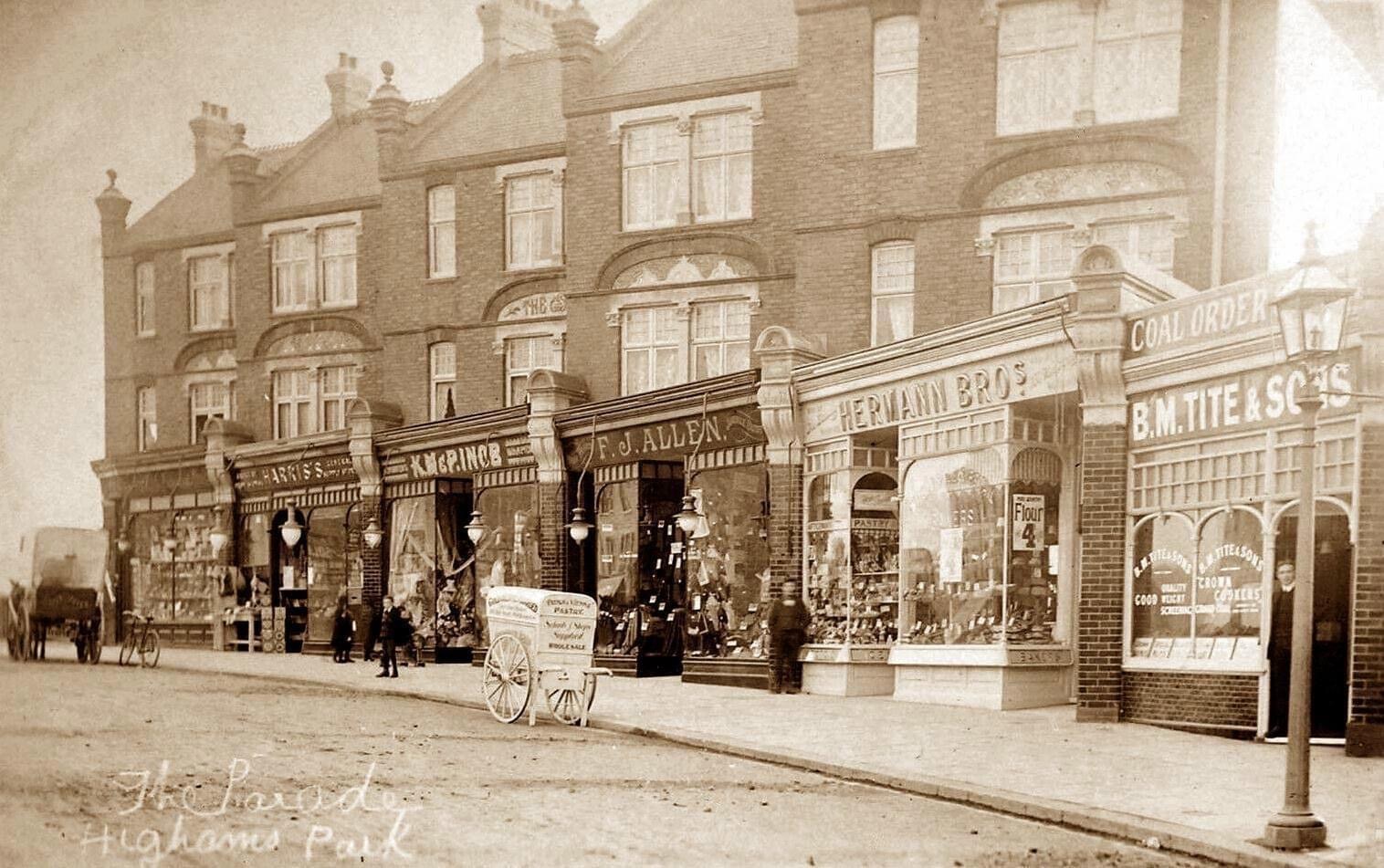
Hale End Road, Highams Park, London An interesting and varied parade of shops in Hale End Road, Highams Park – photographed in around 1900. The Chingford to Liverpool Street railway line is behind the photographer. Image: Photographer unknown (Highams Park Society) The same view on a quiet Sunday morning in February 2021. The disused Regal Cinema can be seen on the left-hand side of the photograph.Image: © Steven Miell (TimeViews) A merged version of the two images above. Use the slider in the centre.
High Road, Leyton, London The above building was completed in 1895 to replace Leyton’s earlier town hall which had been opened only 13 years earlier. It was officially opened by the Duke and Duchess of York in March 1896. This photograph was taken in 1911. The building was described by Nikolaus Pevsner as “fussy but enjoyable, in an eclectic and enriched Italianate style”. The great hall was used for the showing of silent films, prior to The Great War. The building became the Municipal Borough of Leyton’s headquarters in 1927 but ceased to be the local seat of government in 1965, when the London Borough of Waltham Forest was formed. Image: Photographer unknown In 2006, it was sold to a developer and was extensively renovated before re-opening as a business centre in 2010. Apartments also form part of the complex. I took this photograph in February 2021. Image: © Steven Miell (TimeViews) A merged version of the two images above. Use the slider in the centre.




 TimeViews